Where's the Soap? What Hotel Amenities Reveal About the World
March 15, 2026
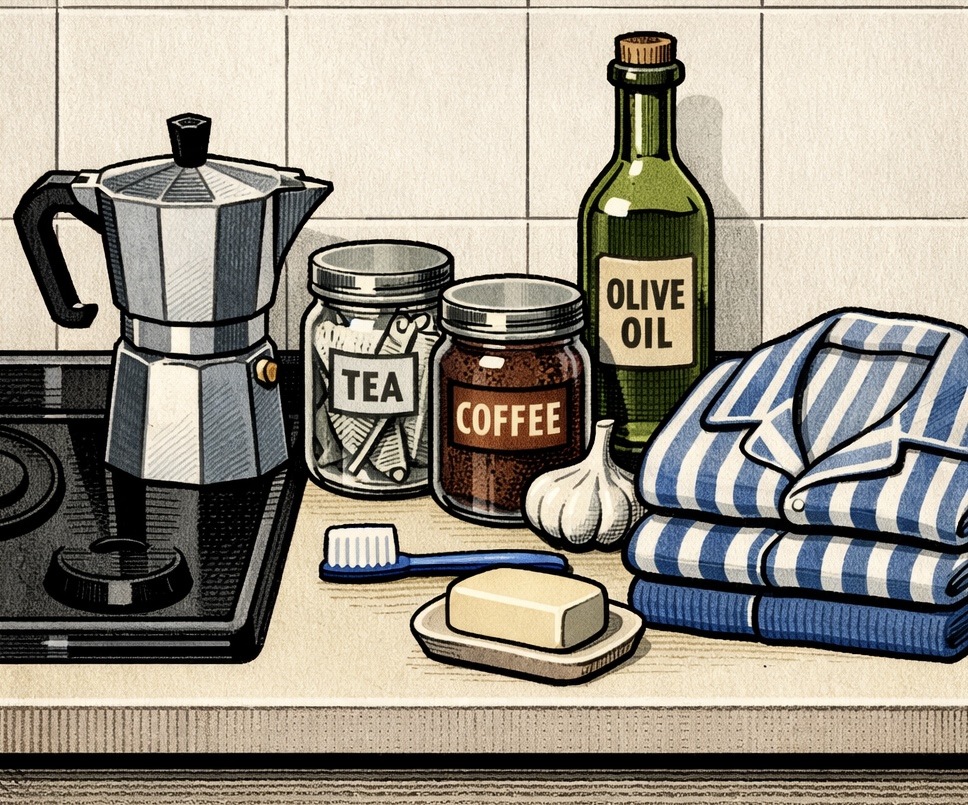
We’d been driving all day when we pulled into Maribor. Like a lot of families passing through Slovenia, we were there for one night on the way to Croatia — the classic stopover. The apartment was lovely: top floor, good light, the sort of place that briefly makes you feel like a more sophisticated traveller than you are.
The boys needed a shower. A full day in the back seat had done what a full day in the back seat always does. Into the bathroom they went. Out they came, still grimy, with a question: “Dad, where’s the soap?”
I checked the basin. The shelf above the toilet. I opened the cupboard under the sink with the desperate optimism of someone who has never once found soap in a cupboard under a sink. Nothing.
This wasn’t a budget hostel. Someone had folded the towels into neat thirds. There were two kinds of tea in the kitchen. But soap? Apparently not included.
Somewhere in the back of my mind, a childhood memory surfaced. Growing up, I’d heard from people who’d done this same drive — the overnight stop on the way to the Croatian coast — that in Slovenia, soap wasn’t provided because it was considered a personal item. Like a toothbrush. You wouldn’t expect your host to choose your toothbrush for you, so why would they choose your soap? It’s a tidy explanation, and I’d carried it around for years without questioning it. Standing there with two unwashed children and no obvious solution, it was the first thing I reached for.
Whether it’s actually a cultural norm or just something one person said to another person decades ago, I’ve never been able to confirm. But it started me paying attention to something I’d never thought about before.
What does a place give you when you arrive?
The Kettle and the Assumption
In New Zealand — and across most of the English-speaking world — you can count on a few things in any self-respecting rental or hotel room. A kettle. Tea bags. Instant coffee. Sugar sachets. Salt and pepper in the kitchen. Maybe a bottle of nondescript yellowish oil that makes you wonder if it was already that sad when it arrived or if it’s been slowly grieving since the last guest left.
We treat this as baseline. Of course there’s a kettle. What kind of place wouldn’t have a kettle?
But even within this supposedly shared standard, there are tells. In the United States, you’re more likely to find a drip coffee maker than a kettle — and often only a drip coffee maker. This is fine if you drink coffee. If you drink tea, you face a choice: use the coffee machine as an improvised kettle and accept that your English breakfast will carry the faint, haunting memory of every cup of coffee that has ever passed through it, or don’t have tea. In the UK and New Zealand, the kettle is king, because the kettle doesn’t presume to know what you want. It boils water. You decide.
Then there are the small local signatures nobody mentions in the listing. In Australia, a well-stocked Airbnb might have Vegemite in the cupboard, sitting there with the quiet confidence of something that belongs. To an Australian host, leaving it out would feel like forgetting the kettle. To an American guest, finding it would raise more questions than it answered.
These aren’t grand gestures of hospitality. They’re the things a culture considers so essential that not providing them would be substandard.
The Oil and the Garlic
In Spain, walk into a holiday rental and open the kitchen cupboard. There’s olive oil. Not a courtesy bottle, not a sachet — a proper bottle, often a decent one. Garlic. Dried herbs.
This isn’t generosity in the way an English speaker might understand it. Nobody is trying to give you a welcome gift. It’s infrastructure. Olive oil in a Spanish kitchen isn’t a nice touch — it’s like a burner on the stove. You wouldn’t rent someone a kitchen and remove one of the burners.
If you cook in Spain, olive oil is where everything begins. It’s the first thing in the pan. It goes on bread, on salad, on things that in other countries would go on a plate unadorned. Providing it isn’t about making a guest feel welcome — it’s about making the kitchen functional.
There’s something clarifying about this. It suggests a version of hospitality that asks not “what would be a nice surprise?” but “what basics would be missing?” The answer, in Spain, starts with oil.
The Slippers and the Boundary
Japan is where the pattern breaks open.
Check into a Japanese hotel — not a luxury ryokan, just an ordinary business hotel — and you will find: slippers by the door, pyjamas folded on the bed, a toothbrush with a miniature tube of toothpaste, and green tea bags. Every single one. This isn’t a lucky find or an upmarket touch — it’s the baseline. The better hotels add more: a small comb, a sewing kit, a shoe-cleaning cloth, the kind of miniature provisions that suggest someone sat down and thought very carefully about every small thing that could go wrong on a trip.
To someone from the Anglosphere, this feels lavish. A toothbrush? Pyjamas? In every business hotel? It’s like the entire country anticipated that you might arrive with nothing but your passport and still wanted you to be comfortable.
But look closer and the logic isn’t about luxury — it’s about boundaries.
The slippers are the giveaway. In Japan, there is a deep and carefully maintained distinction between inside and outside, clean and unclean. Your shoes carry the outside world on their soles. Providing slippers isn’t a perk; it’s closer to a polite instruction. Here — wear these. Leave the street at the door. The layers of separation are precise.
The pyjamas follow the same logic. Your travel clothes are outside clothes. The yukata is for inside. Changing into it isn’t just comfort — it’s a transition, a way of marking that you’ve arrived, that you’re in a different space now.
And the toothbrush? It’s simply practical. You might have forgotten yours. Or simply don’t need to carry yours. Or pyjamas, or slippers. It’s much easier to travel light. It’s efficiency dressed as generosity.
The Line You Can’t See
Here’s what makes the Slovenian soap — or the absence of it — so interesting, even if the cultural explanation I was given turns out to be one person’s opinion rather than national policy.
In Japan, a toothbrush is basic provision. Of course the hotel provides a toothbrush. In Slovenia — or at least in one very nice apartment in Maribor — soap was apparently too personal to assume. Both are hygiene items. Both touch your body. But they land on opposite sides of an invisible line, and neither side thinks their placement is unusual.
Every culture draws this line somewhere. On one side: things we obviously provide. On the other: things you obviously bring yourself. And the line is so deeply embedded that we don’t see it as a line at all. We see it as common sense.
The New Zealander sees a kettle and thinks: yes, obviously. The Spaniard sees olive oil and garlic and thinks the same. The Japanese hotel sees slippers and pyjamas and a toothbrush and thinks: of course — what kind of place wouldn’t?
And a tired father in Maribor sees an empty shelf where the soap should be and thinks: something has gone wrong.
But nothing went wrong. I just crossed a border I didn’t know was there. Not the one I’d crossed earlier that day by car — the other kind, the invisible one that runs through bathrooms and kitchens and the quiet assumptions of daily life. The one you can only find by standing on the wrong side of it, with two grubby children and no obvious plan B.