The Fiddly Magic of the Moka Pot
April 30, 2026
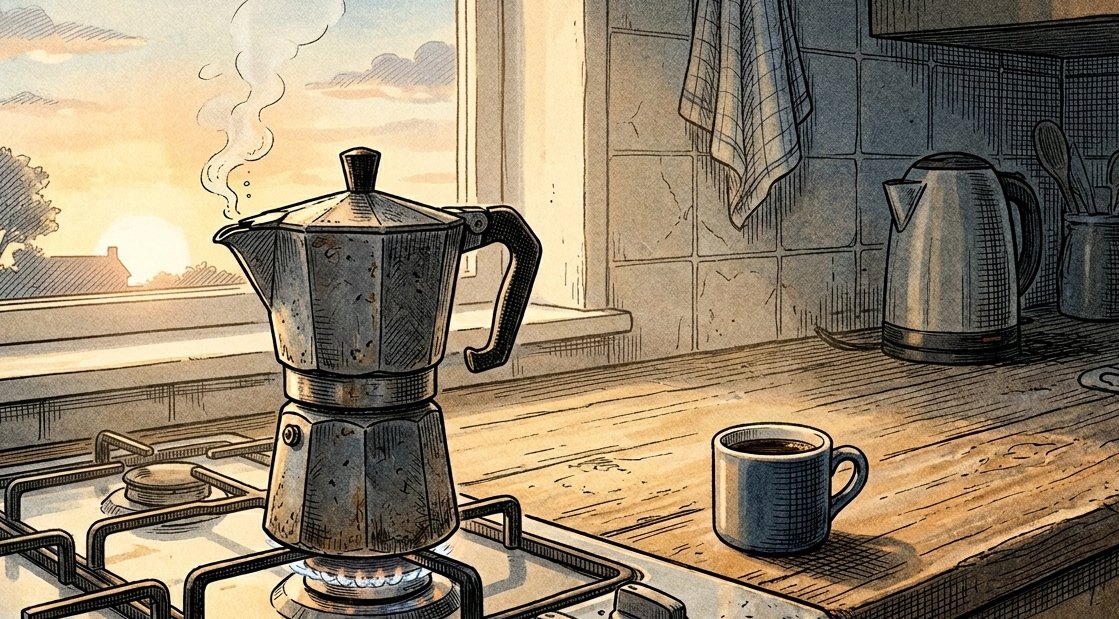
My first real encounter with a moka pot was in Estonia, back in 2007. I was twenty-three, at a student organisation event one morning. The coffee was much needed. Someone had brought out a massive, stovetop moka pot to make strong coffee for the group, and I remember standing there, watching the dark liquid suddenly push its way up through the central column and spill into the top chamber. It felt like magic.
Moka pots weren’t really part of the Czech kitchens I grew up around in the 90s and early 2000s, so that Estonian morning was genuinely my first introduction to the strange little machine. It would be years before I saw one again—around 2023, at my parents-in-law’s house in New Zealand, sitting near the stove. I never saw it in use.
Then came Naples, January 2025. I was visiting a small supermarket with my four-year-old son. We had gotten sick, and we were just trying to get through the day. The owner, seeing a tired father and a coughing child, did what Italians do: he offered me a coffee. He made a point to explain that it was not made by a machine. Only later I realised it came from a moka pot. It came in a tiny plastic cup, made by a relative in the back. It was incredibly delicious, but what struck me most was the size. It was microscopic. It perfectly demonstrated what a true Italian “portion” actually looks like. It wasn’t a beverage you nursed; it was an injection of life.
The final push came recently in Spain. We were staying in a holiday rental that had a moka pot in the cupboard. I asked AI how to use it and made it myself for the first time. The coffee was excellent—black, sweet, and it reminded me of how I used to drink black coffee years ago. It paired perfectly with Spanish bread, heavy with olive oil, garlic, and tomatoes.
My eleven-year-old was intrigued. He tried a small spoon on the first day and thought it was delicious. He asked for more on the second day. But on the third day, he took a sip, grimaced, said “fuj!” (yuck), and pushed it away.
That was my introduction to the core truth of the moka pot: it is brilliant, and it is incredibly fiddly.
The Portion
When we got back from Spain, I deliberated for a few weeks before finally buying my own. I bought a classic aluminium pot, sized for “three portions.”
In Northern Europe or the Anglosphere, we hear “three portions” and picture three mugs sitting on a breakfast table. But the moka pot was invented in 1933 in Italy, and it operates on 1933 Italian coffee math. A “3-portion” moka pot produces about 100ml of coffee, just enough to fill a small mug. It made sense only when I remembered that tiny plastic cup in the Naples supermarket. The moka isn’t designed to give you volume; it’s designed to give you density.
Frozen in 1933
There is a reason the moka pot feels like a snapshot from another era. It is one.
When Alfonso Bialetti patented his pot in 1933, his marketing slogan promised “un espresso come al bar”—an espresso just like at the [coffee] bar. And in 1933, that was literally true. Commercial café machines of the era ran on steam pressure, producing roughly 1.5 bars—the same as a moka pot. There was no thick golden crema yet. There was no syrupy shot. Café espresso and home moka were the same drink.
The legend goes that Bialetti’s inspiration didn’t come from coffee machines at all, but from washing machines—specifically the lisciveuse, a domestic boiler with a central tube that forced hot soapy water up and over a pile of laundry. He saw the principle and shrank it down. The moka pot is essentially a tiny laundry machine for coffee.
Then, in 1947, an Italian café owner named Achille Gaggia invented a lever-piston system that forced water through coffee at 8 to 10 bars of pressure. The extreme pressure emulsified the coffee oils and produced, for the first time in history, the thick golden foam we now call crema. Café espresso became something new. The moka pot stayed exactly where it was.
It still does. Which is why a moka pot will never give you the crema of a café espresso—you’re not using a broken espresso machine, you’re using a working pre-espresso machine. Italians have known this particular disappointment long enough to invent a workaround for it: the cremina, where you catch the very first few drops, whip them with sugar into a pale paste, and float that on top of the cup to fake the foam.
The Internet vs. Reality
Beyond the history, the internet is full of “golden rules” for the moka pot. Baristas and coffee purists issue strict commandments about how it must be used. I’ve found that the rules don’t always match the reality of a Tuesday morning in your own kitchen.
The Hot Water Rule: The internet insists you must start with boiling water in the base. If you use cold water, they say, the coffee grounds will “cook” in the metal before the water even begins to boil, ruining the flavour.
My experience: I find very little difference. If you heat cold water quickly, or heat hot water slowly, the result is largely the same. The stove controls the outcome, not the starting temperature of the tap.
The Tamping Taboo: The absolute strictest rule online is to never tamp or compact the coffee grounds. You must gently level them, or risk a bitter cup—or worse, a pressure explosion.
My experience: In my specific pot, I actually need to overfill the basket slightly and compact the grounds a bit to get the best flavour and extraction. As a small bonus, the extra packing produces a thin layer of foam on top—not the real crema of a 9-bar espresso machine, but the closest a moka pot can manage. It turns out I’m not entirely alone in breaking this rule; Cubans aggressively pack their cafeteras to get a stronger, punchier brew. I don’t go that far. I lightly press with a spoon to make the surface smooth. It is not what you do for the espresso machine at the edge of your benchtop with the dedicated tamper. Like with the espresso machine, the pressure that builds up depends heavily on your specific model (how fine and how numerous are the filter holes) and the grind of your beans.
The Sputter: There is one internet rule I completely agree with: letting the extraction run too long ruins the coffee. In the last few moments of the brew, the remaining water, steam, and foam violently push through the spout together, making a loud sputtering sound. This extracts all the harsh, bitter compounds. The trick is to take the pot off the heat, or pour the coffee out, before that steam starts pushing through. (This is also why I keep the lid open—not because I believe the popular warnings about coffee “cooking in its own steam,” but because I want to see the sputter coming. The pot only really cooks the coffee if you foolishly leave it on the hot stove long after brewing has finished.) It needs to be noted that the pouring out is the tricky part. Unless you do what some internet sources suggest and cool the bottom of the moka pot, when you pour you will get steam coming through because of the tilt of the pot. I find that it doesn’t affect the taste enough to warrant the cooling but those who demand the best possible cup might find it worthwhile.
Washing: The Detergent Debate and the Dishwasher Trap
The internet has two strong opinions about washing a moka pot, and only one of them stands up.
The dominant online rule is to never use any detergent at all. The reasoning is flavour: detergent, the argument goes, will dull the seasoned coating of coffee oils that builds up inside the pot and ruin the taste. Just rinse with hot water and let the pot “season” itself over time with the coffee flavour.
I don’t find that argument especially well founded. Over months and years, those oils don’t lovingly season the aluminium—they go rancid. A pot that has been “preserved” for years with hot-water rinses only is, I suspect, a pot quietly developing a stale, off-flavour residue that gets harder to remove the longer it sits there.
The other rule, though, has hard chemistry behind it: never put a moka pot in the dishwasher. Classic moka pots are made of aluminium, which protects itself with a microscopic, self-healing shield of aluminium oxide. The shield is stable in neutral conditions, but it dissolves in alkaline ones—and most dishwasher detergents are aggressively alkaline. Once the shield is stripped, the raw metal reacts with the hot water and produces a thick, non-adherent layer of aluminium hydroxide. If you’ve ever put an old stovetop espresso maker in the dishwasher and had it come out covered in a chalky, dark grey “smut” that rubs off on your hands, this is why.
In practice, what I do is part hedge, part laziness. Most of the time I just rinse with warm water by hand—it’s quicker, and it’s also what the no-detergent crowd recommends. But every couple of weeks I wash the pot properly with a small amount of standard dish soap, to lift any coffee oils that are starting to turn before they have a chance to settle in. Warm water, a sponge, no steel wool, no dishwasher.
Embracing the Inconsistency
The moka pot is not a capsule machine. You do not push a button and receive an identical, engineered product every single time. It is a tactile, analogue piece of 1930s engineering. A little coffee engine from the steam era on your stove top.
Because it relies on the exact grind of the bean, the heat of the stove, and your own timing to catch it before it sputters, it is inherently inconsistent. Sometimes you get the perfect, nostalgic cup that pairs flawlessly with Spanish bread, tomato, and garlic. Sometimes you get a cup that makes an eleven-year-old say “fuj!”
But that inconsistency is the charm. It asks you to pay attention. It asks you to learn its quirks, to ignore the internet when necessary, and to figure out what works in your own kitchen. It brings a piece of that Naples supermarket, that morning in Estonia, and those breakfasts in the Spanish countryside onto my stove every time I use it.
It takes a bit of practice. But when you get it right, watching the dark liquid push its way up through the central column still feels a little bit like magic.