Sicily: Slow at Intersections, Fast on Blind Crests
May 13, 2026
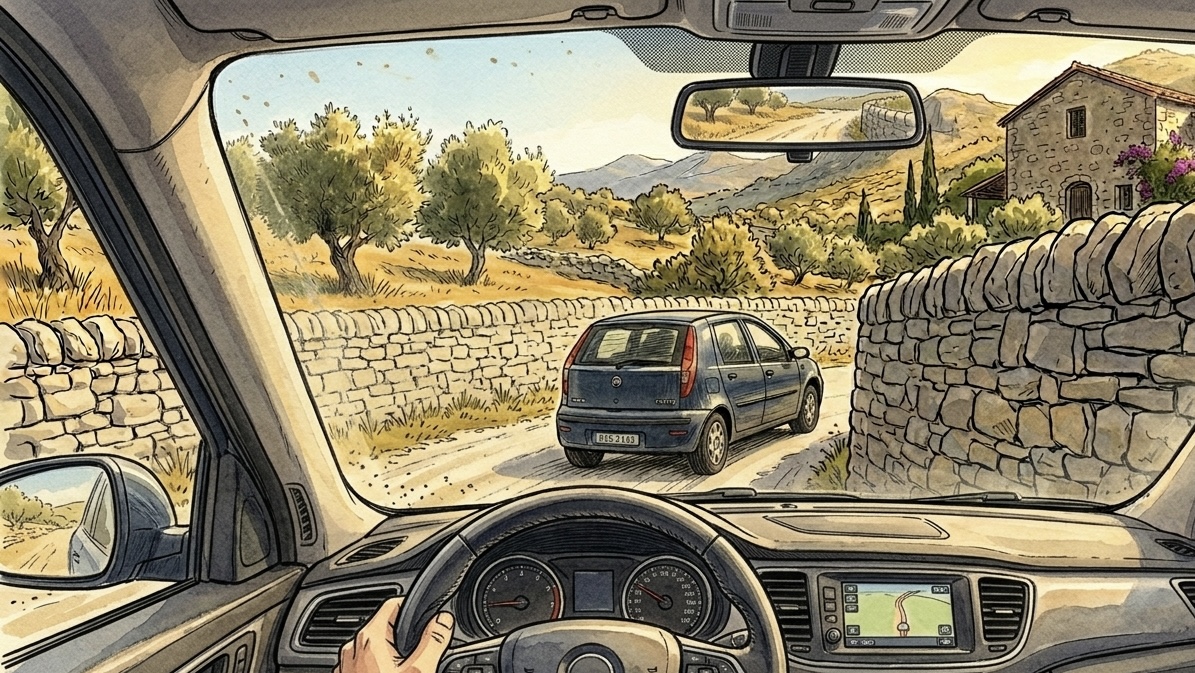
The first thing the man at the rental counter in Catania did was try to sell me roadside assistance. Not gently. He explained, with what I can only describe as enthusiasm, that if I broke down outside the region of Catania the fees would be eye-watering. I declined. He shrugged. He handed me the keys to a slightly battered hatchback with a broken boot cover and 70,000 kilometers on the clock, then — after I pointed at the boot — gave me a brand-new car with seven kilometers on it instead.
I took the new one and immediately wondered if I’d made a mistake. The beat-up car would have looked like it belonged. The new one looked like a tourist.
That distinction, it turned out, mattered more than I expected.
On our first nigh I drove into a pothole I didn’t see. The car shook hard. There were two distinct, sickening noises — one for each left wheel — and my wife, sitting on the opposite side, said the impact hurt her neck. The car was somehow fine.
That pothole was my introduction to the actual logic of Sicilian roads, which I’ll summarize this way: Sicily doesn’t fix its roads. It lowers the speed limit instead.
You notice it after a few days. Roads that look perfectly drivable are signed at 50 or 70 km/h. There’s no obvious reason — until there is. A sharp turn on an otherwise straight stretch. A pothole the size of a soup tureen. A collapsed shoulder. The number on the sign isn’t a measure of how fast the road can be driven; it’s a hedge against what the road is hiding.
Locals know what the road is hiding. They drive faster. Tourists don’t. They drive slower. And that gap — between the people who know and the people who don’t — is the actual organizing principle of driving here.
It explains the overtaking, which on first encounter looks suicidal. I watched cars pass us before the crest of a hill, just before a blind turn, in places where my Northern European brain was screaming they cannot possibly see what’s coming. And they couldn’t. That’s the point.
The driver overtaking before the crest isn’t gambling that nothing is coming. They’re trusting that if something is coming, that driver will also be reading the situation — also paying attention, also ready to ease off or move toward the shoulder. And the driver overtaking will, in turn, do the same when somebody else does it to them. I overtake at the crest; I move out of your way when you overtake me at the crest. It’s reciprocal. It’s a contract.
Confidence is currency in this system because confidence is information. If you commit, other drivers can read you and plan around you. If you hesitate, you become unpredictable — and unpredictability is what actually causes accidents, not speed, not boldness. The cautious tourist who brakes halfway through an overtake is more dangerous than the local who finishes the move.
Once I saw the contract, I started seeing it everywhere.
The roundabouts in towns where four streets meet at strange angles, where the formal rule of right-of-way would mean total deadlock — you have to nose in, and you’ll be let in. The blind corners on country roads with shoulder-height stone walls and unkept grass, where you literally cannot see the road you’re joining until your bonnet is already in it — locals do this slowly, deliberately, expecting oncoming traffic to absorb them. The few cyclists I saw rode noticeably away from the verge, where drivers could see them earlier. The truck that nearly ran us off the road on our last day, trying to reach a cargo entrance from behind one of those blind walls — it was moving slowly because it expected to be read.
This is what travelers and researchers both get wrong about Sicilian driving. Academic studies tag a “high-risk subgroup” of drivers, overconfident and irresponsible. Reddit threads talk about chaos. Neither is quite right. The same driver who edges politely into a town roundabout will pass you on a blind crest twenty minutes later — and both behaviors are expressions of the same skill. Read the system; be readable inside it.
The tourist’s problem is that you can’t do either. You can’t be read, because your responses don’t match the script — you brake when a local would accelerate, you hesitate when a local would commit, you flinch at gestures that aren’t aggression but information. And you can’t read others, because you don’t know what comes next.
So you experience the system as chaos. It isn’t chaos. It’s a working equilibrium that has, over decades, substituted social trust for civic infrastructure. The roads stay broken because the drivers compensate. The drivers compensate because the roads stay broken. The signs say 50 because the asphalt can’t be trusted. Other drivers can, which is why they overtake at the crest.
Whether that’s Italy’s genius or its tragedy depends on whether you’re inside the contract or outside it. Probably both.
A few practical notes for anyone planning to drive there, in case the philosophy isn’t useful by itself:
Take the smaller car, just make sure it’s big enough for your luggage. Take the older car if they offer you the choice — a few scuffs already on it means you’ll stop flinching every time someone passes you with three inches of clearance. Treat speed limits as information about the road surface. Don’t overtake at the crest yourself. Assume every parked car may suddenly open a door and every blind corner contains a truck or an oncoming car. Hold your line. Be predictable. That’s your half of the deal.
We returned the new car at Catania airport with no damage, just a thin film of Sahara dust from the scirocco wind. The rental guy didn’t even look at it. The shiny car came back looking like a tourist that had survived the trip. I handed over the keys, glad I could say the same.