From Mosty to Ostravice: A Ridge Walk Through Memory
August 9, 2025
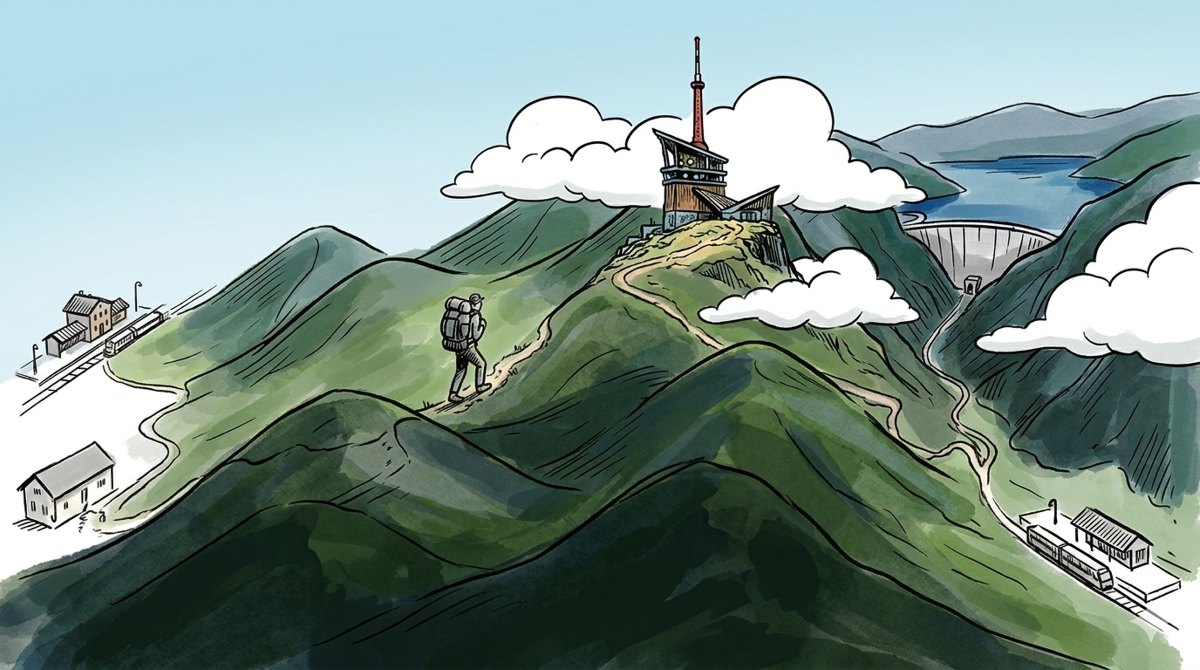
Still temporarily childless and wife-less, another opportunity for a moderately demanding adventure. This time I found myself drawn to routes ending in Ostravice—the promise of that excellent burger and langoš place proving an irresistible motivator. I plotted several options into my Garmin, ultimately settling on a traverse from Mosty u Jablunkova to Ostravice, connecting two separate train lines across the Beskydy ridge.
Morning Departure
The early train from Ostrava started nearly empty but filled as we approached Český Těšín. Perfect hiking weather greeted me: overcast skies, barely any wind, and temperatures reaching 28°C. Surprisingly, České Dráhy arrived on time—a minor miracle worth noting.
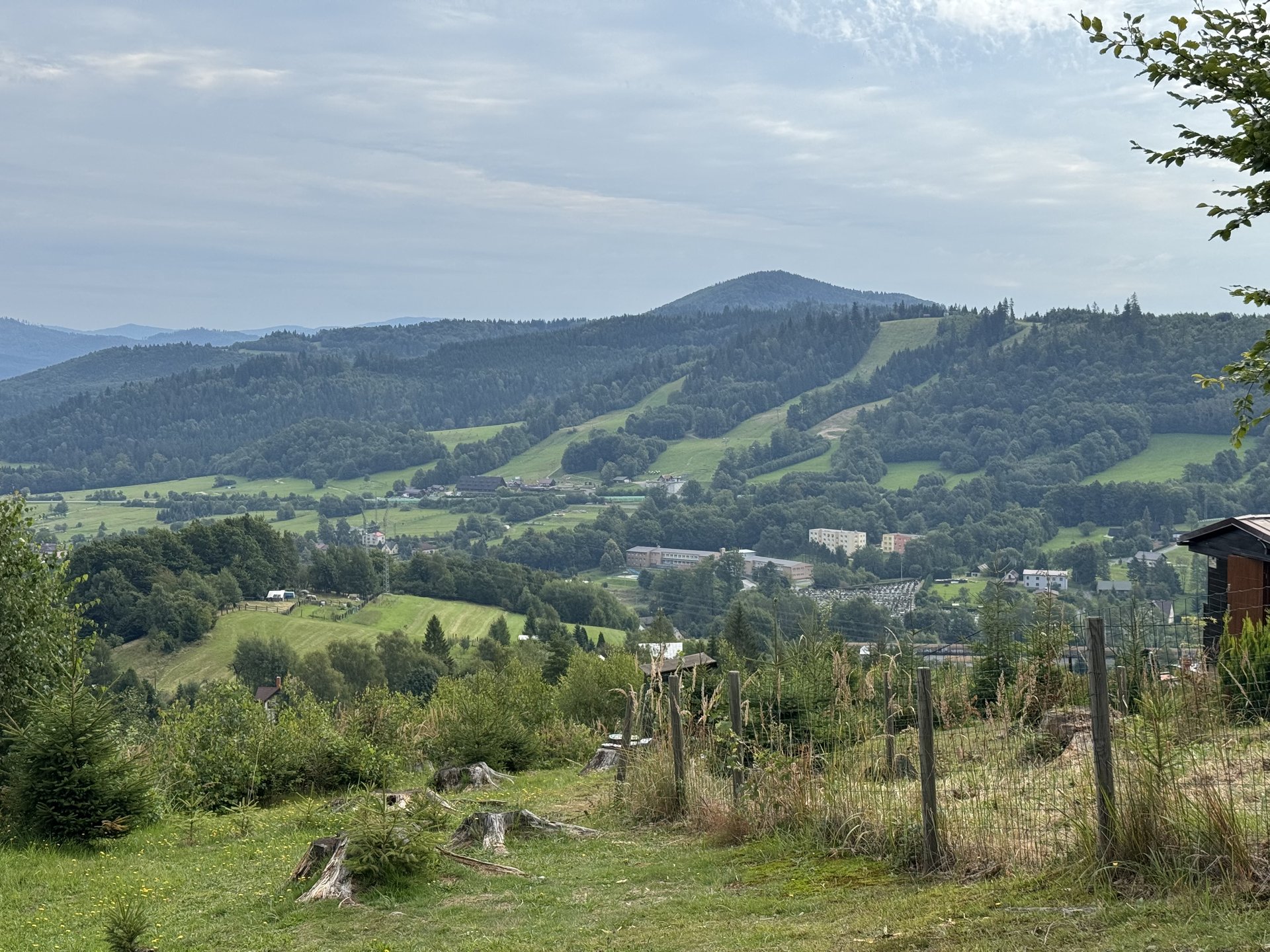
Following the red trail out of Mosty u Jablunkova, I quickly left the urban area behind. Within ten minutes, picturesque chalets appeared with beautiful valley views opening below. The trail wound through wild blueberry bushes and young spruces. I couldn’t resist picking some berries myself. The blackberries were delicious, though not quite at peak ripeness—probably another week. The blueberries seemed more picked over than during my Lysá Hora adventure the previous week.
A pair of older hikers approached, their poles clicking a steady rhythm on the trail. I decided to test my theory. “Ahoj,” I offered, a little hesitantly. A warm “Ahoj!” came right back, confirming it. This was mountain etiquette here too: the formal “Dobrý den” was left for the mountains of my childhood memories and for the cities below.
As I climbed higher, vegetation grew sparser with shorter spruces, but the views improved dramatically. The West Carpathian mountains stretched into Slovakia, with the Low Tatras clearly visible in the distance. I found a few wild strawberries past their prime.
Mountain Hotels and Along the Border
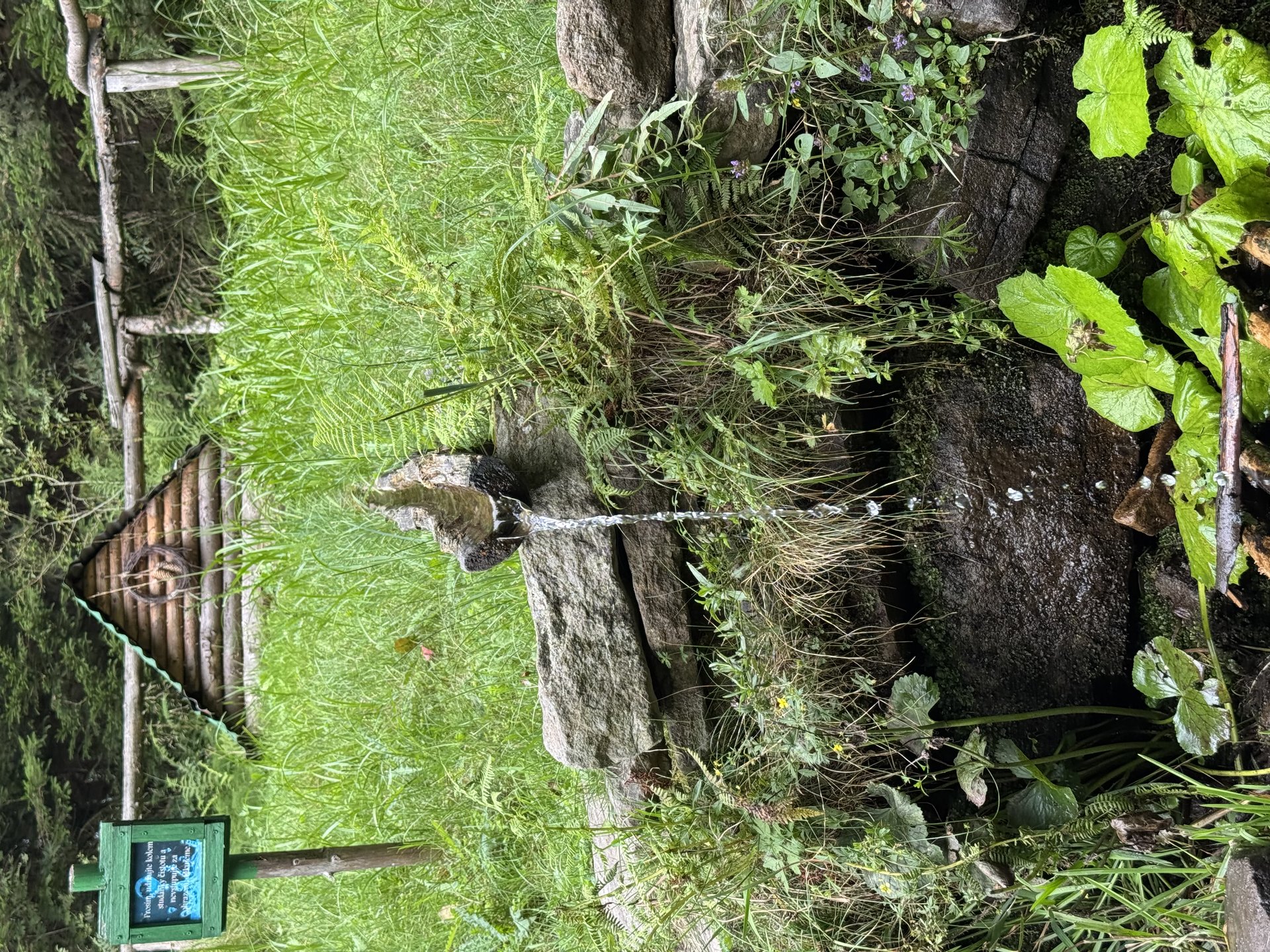
The path entered dense forest with beautiful spruces and meadows, later becoming rockier with many tall, sometimes dead trees. I passed a lovely wooden chalet hidden among trees with a mountain spring nearby. I washed my face with cool water flowing through a long pipe.
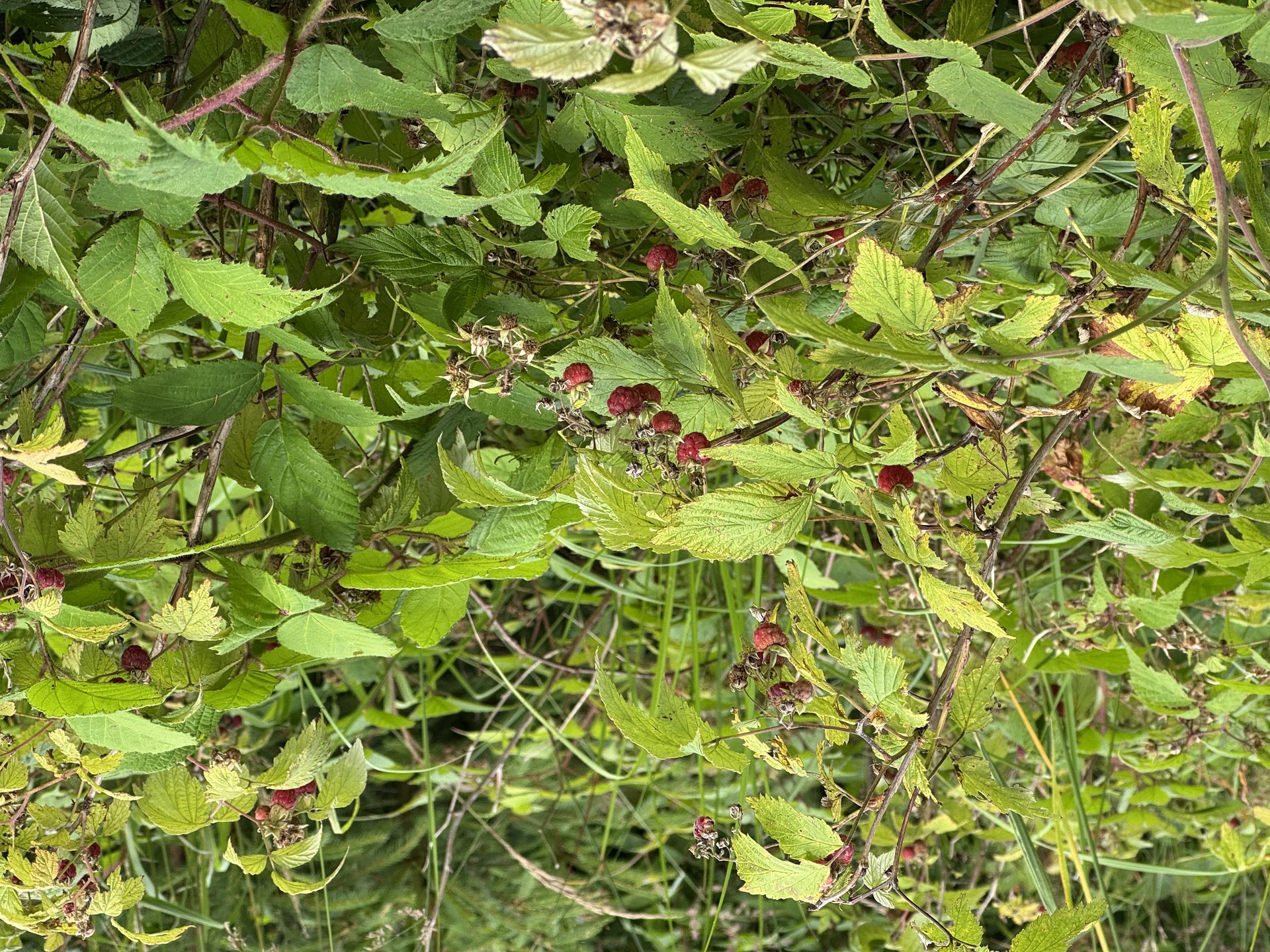
Wild raspberries grew abundantly here—incredibly sweet and flavorful, far superior to cultivated varieties. The forest seemed generous today with its gifts. Throughout the morning, I’d passed mushroom pickers bent low among the trees, their wicker baskets already heavy with prized porcini. Like my handful of raspberries and wild berries, these were the rewards for those who knew where to look, who took time to see what the forest offered.
Further along stood Chata Skalka, a picturesque wooden mountain hotel with its metal roof gleaming. Too early for me to stop, though clearly they served meals and offered accommodation. A well-maintained gravel road led to it, solving the mystery of supply deliveries.
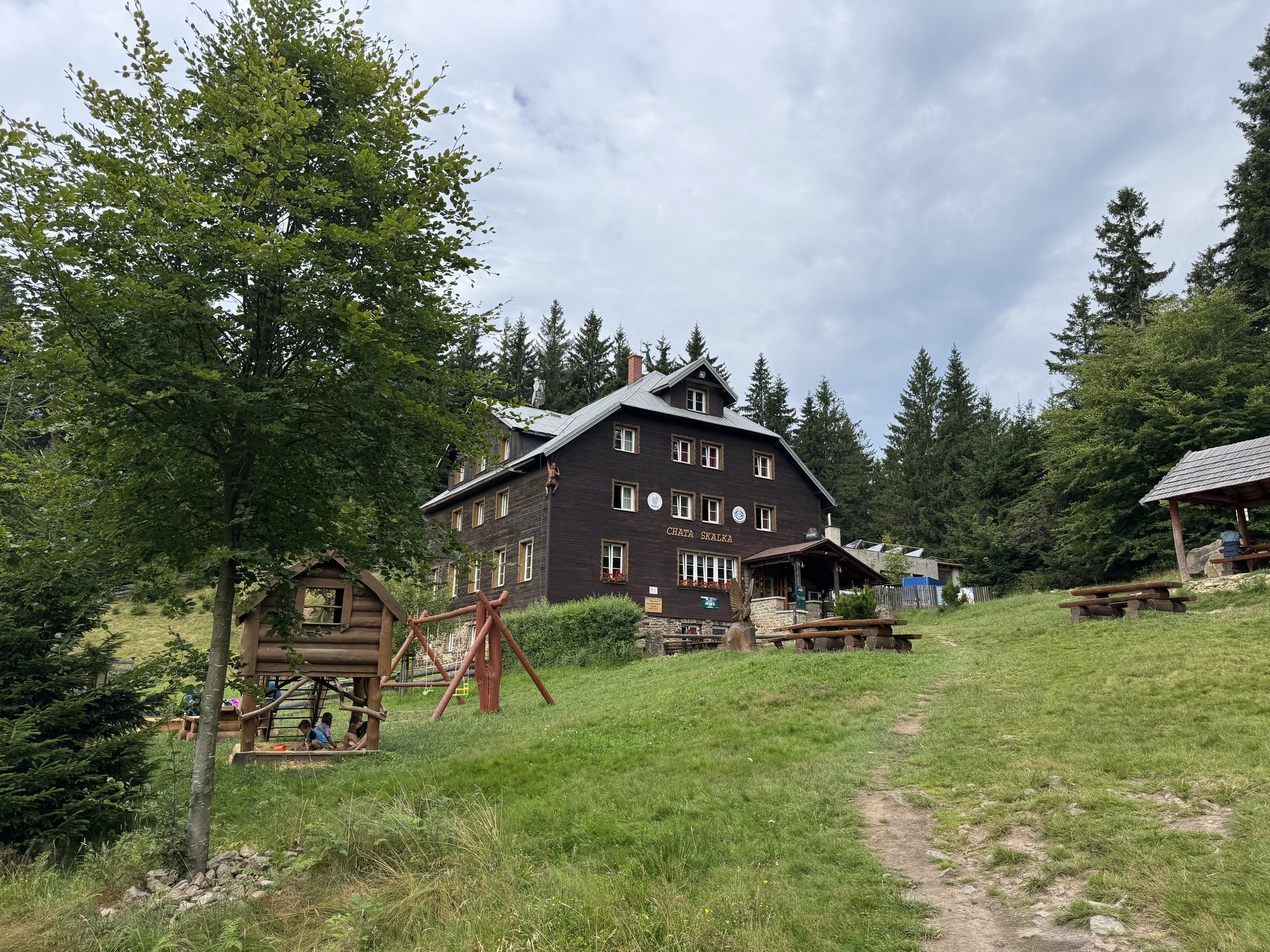
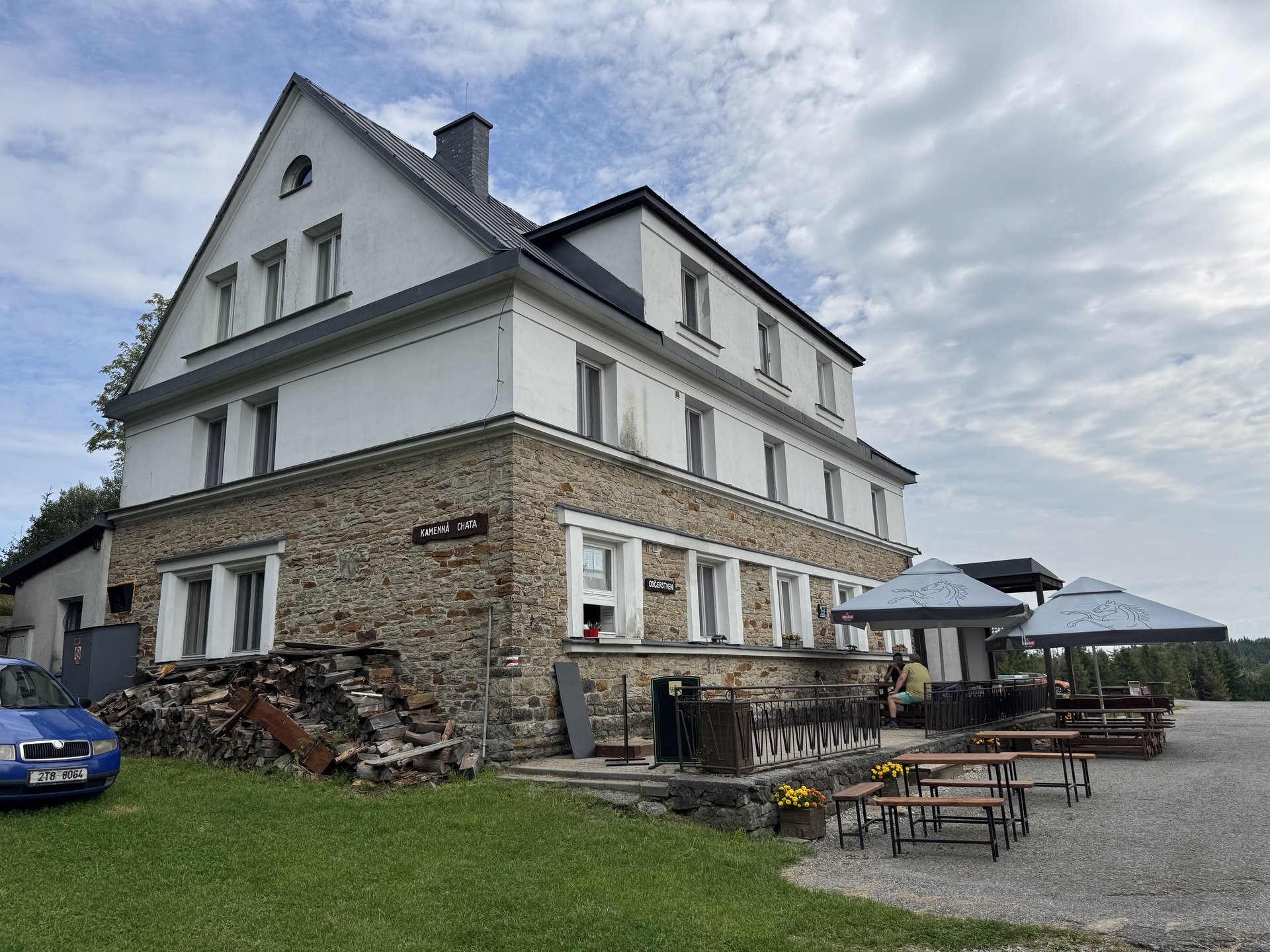
After Skalka, the trail leveled onto a flat gravel road following the ridge. Views opened toward Třinec and the northwestern Beskydy, where ski lifts promised excellent winter skiing. At the Kostelky intersection (930m elevation), signs pointed for the first time toward Bílý Kříž—a place of many childhood memories of mine, still 16.5 kilometers away. Just past the intersection, spectacular views opened toward Slovakia again. The Low Tatras stood crystal clear, and in the distance, what might have been the High Tatras—absolutely magnificent scenery. Shortly after Kostelky I walked by another mountain hotel Kamenná Chata (Stone Chalet), which indeed looked made of stone, some hikers already taking the opportunity to source refreshments there. Still too early for me to stop, the next chance for getting refreshments was 15 km distant Bílý Kříž.
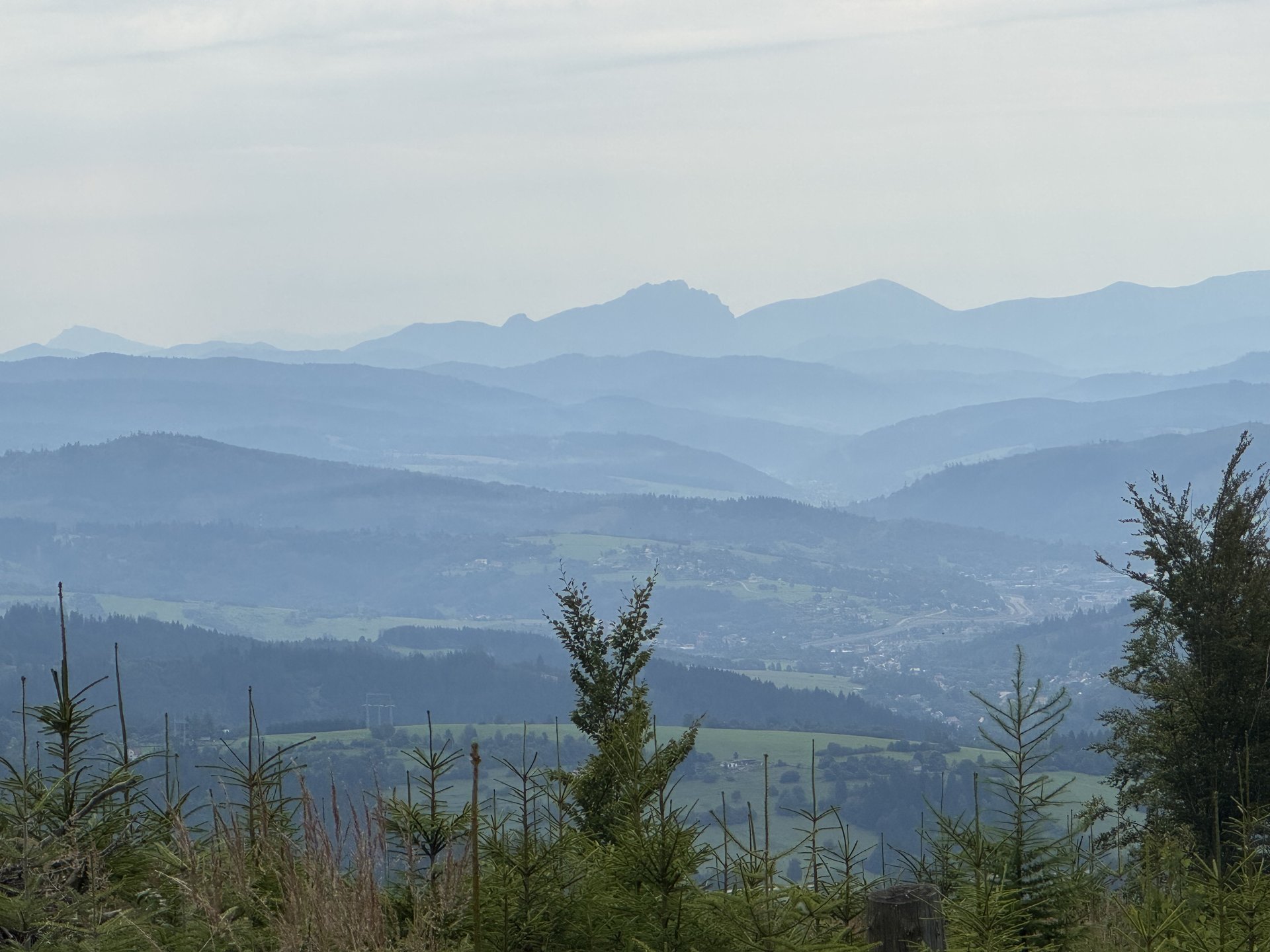
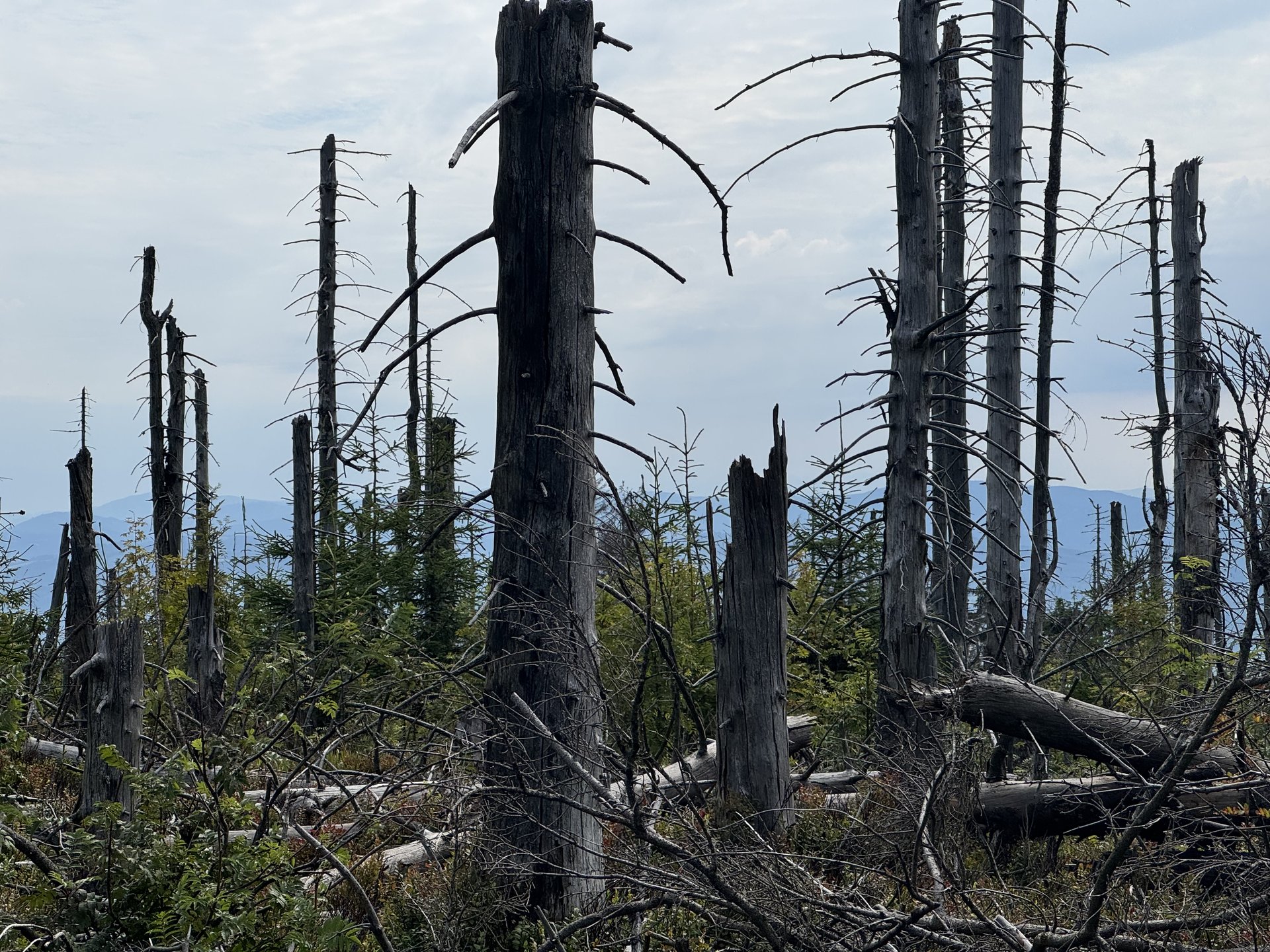
The track wove in and out of the Czech Republic along the Slovak border—a path likely forged in Czechoslovak days. Near Velký Polom, dead spruces dominated the landscape, similar to Smrk but with more young growth, no more than ten years old. Near Malý Polom, mud frequently covered the path, testament to numerous springs in the area. I found only one studánka in this section—an uninspiring trickle from a pipe pushed into rocks.
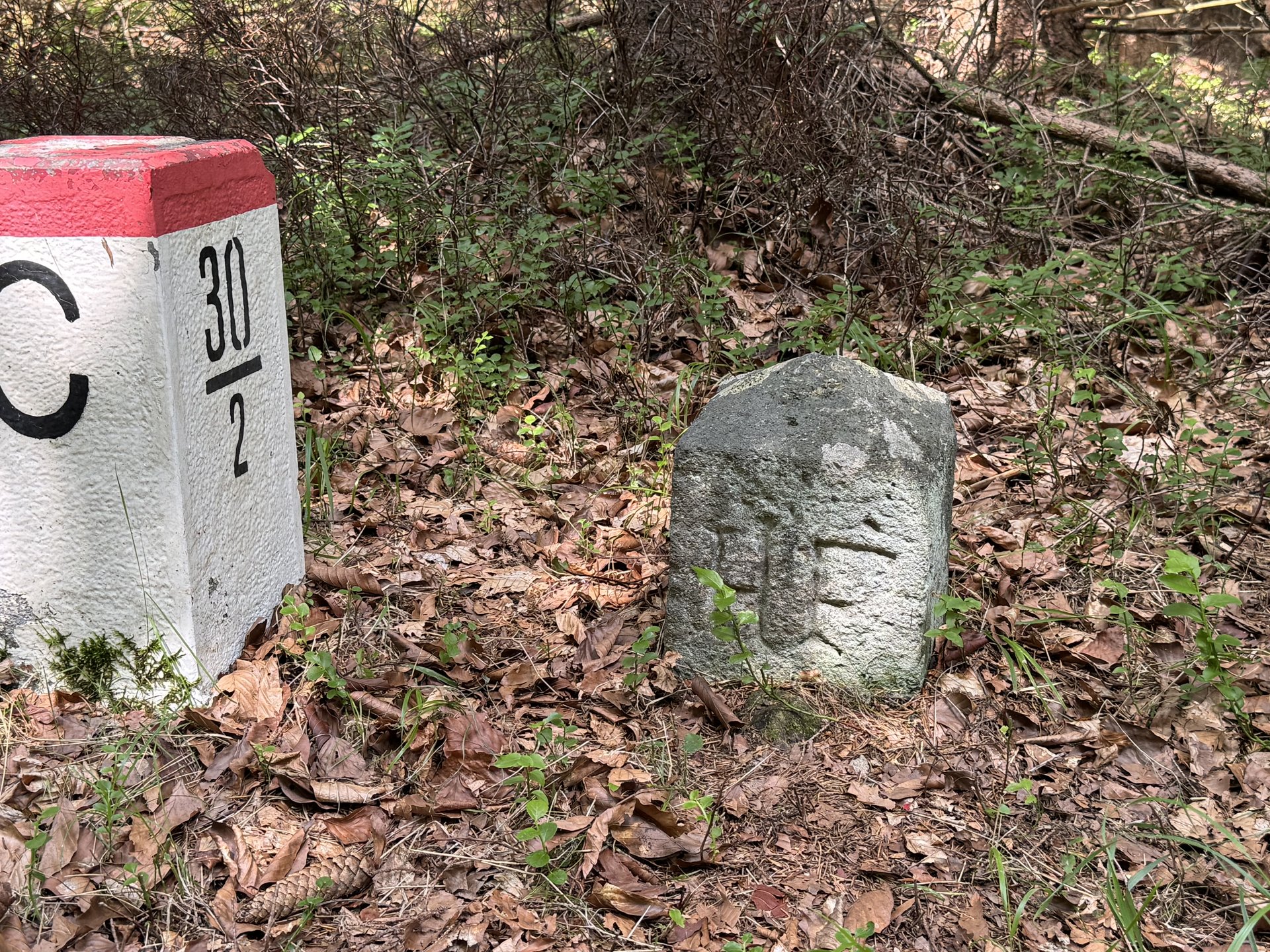
Ghosts of Bílý Kříž
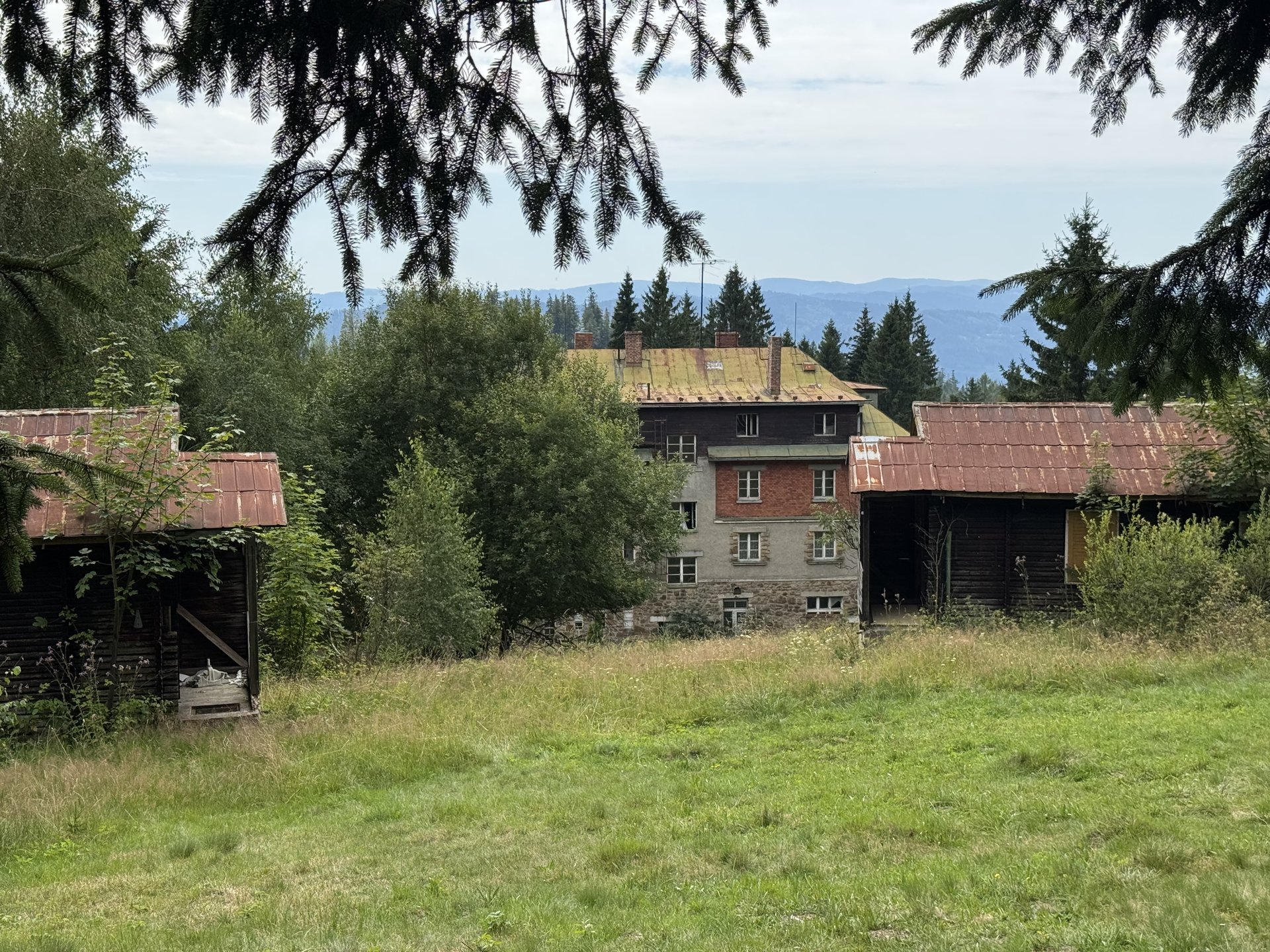
Approaching Bílý Kříž stirred childhood memories. I recognized a chalet from those days and wondered if they’d fixed their small wind turbine—already broken twenty years ago. They hadn’t. Not only was it still non-functional, but thoroughly corroded and overgrown by encroaching trees.
This area once boasted three hotels where my parents took me for summer and winter holidays. The two on the Czech side have been transformed into apartment buildings. The real heartbreak came at Hotel Kysuca on the Slovak side—a wonderful mountain chalet likely built at the dawn of the 20th century. Where families once gathered, broken windows now stared blindly, and small wooden chalets stood in disrepair, vandalized based on the broken sink discarded outside. I remembered the dining hall with its wood-lined walls and mounted antler trophies, where all guests would start dinner together at the sound of a bell. I remembered picking mushrooms with my parents on these very slopes, then returning to our room to clean and slice them, threading them on string to hang across the window. For days afterward, our room would smell of forest and earth—the mushrooms slowly drying in the mountain air, our only way to preserve the bounty when staying for a week. Now, earlier on the trail, I’d passed mushroom pickers with their wicker baskets full of porcini, continuing the tradition. But they had homes to return to, kitchens with modern dryers or freezers. The windows of the Kysuca would never again frame drying mushrooms; they were dark, vacant eyes staring at a past only I could see.
I passed the actual Bílý Kříž (White Cross) and the large greenhouses where researchers study plant growth under elevated CO2 levels—they pump extra carbon dioxide into these structures, preparing for our changing world.
At that point, my Garmin urged me toward Gruň, but a pull toward the past was stronger. I decided to detour from my planned route, descending toward Visalaje with the goal of revisiting Masaryk Valley, a place I hadn’t seen since childhood.
Valley Disappointments and Surprises
I remembered a beautiful natural studánka here, just after the turn off to Visaláje—a small pond surrounded by stones set into a steep bank. Unfortunately, either landslides or faulty memory had transformed the landscape. I only found small plateau with a concrete structure, water barely trickling.
I stopped for my first real food—canned mandarins. Five hours into the walk, sustained only by orange juice and wild berries, I wondered why hunger hadn’t struck.
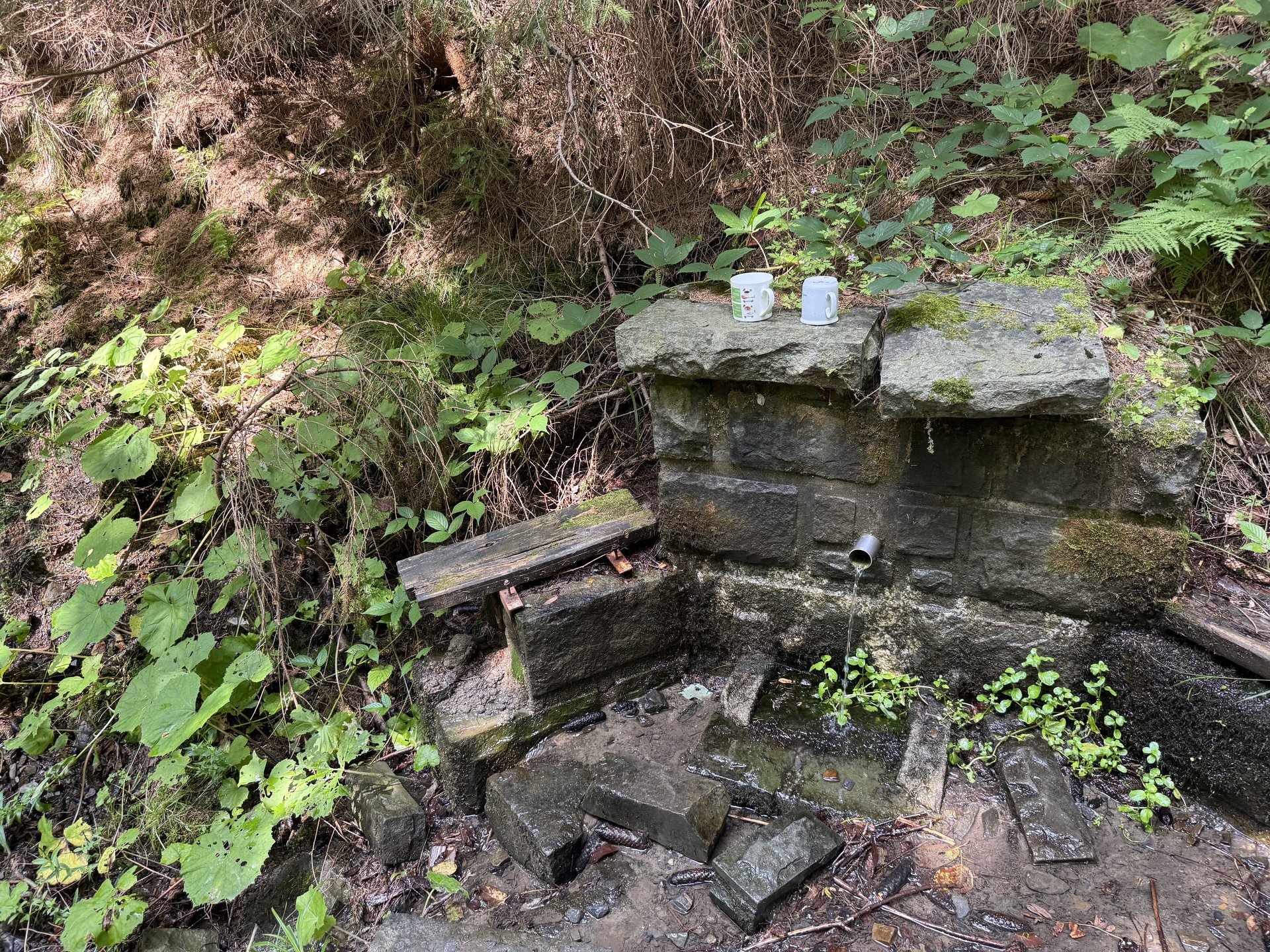
Further down the busy gravel road, a surprise awaited: a new studánka that definitely wasn’t there twenty years ago. A small wooden structure with mugs hanging ready, providing a good stream of ice-cold water. As if the mountain had relocated its gift, compensating for what was lost above. Refreshed—by the discovery as much as the cold water—I continued with renewed spirit.
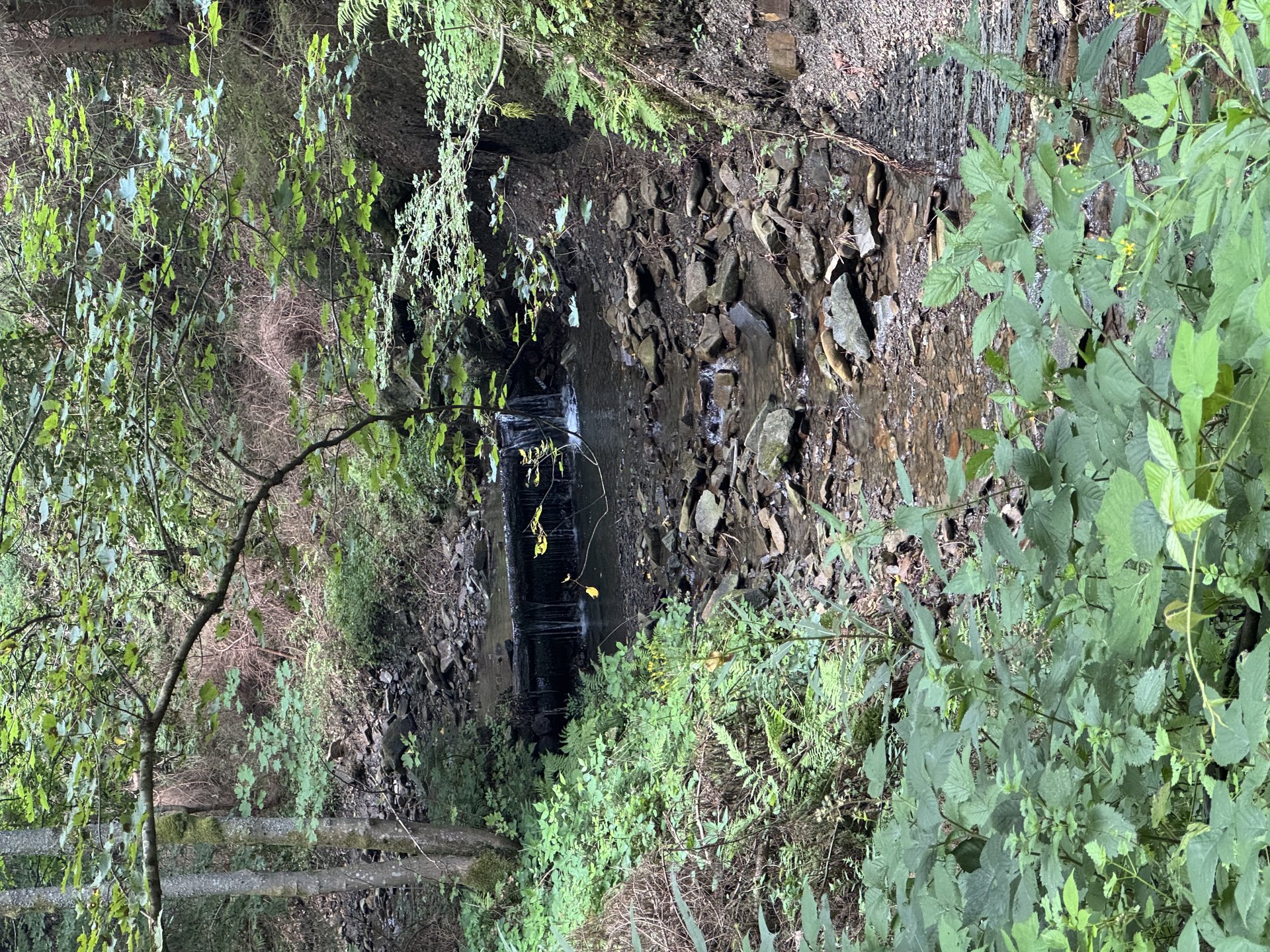
Masarykovo údolí (Masaryk Valley) didn’t match my memories either. Perhaps the logged areas nearby, or the trees growing taller, transforming from young green spruces into tall specimens with brown trunks and dead lower branches, greenness reserved for the canopy far above.
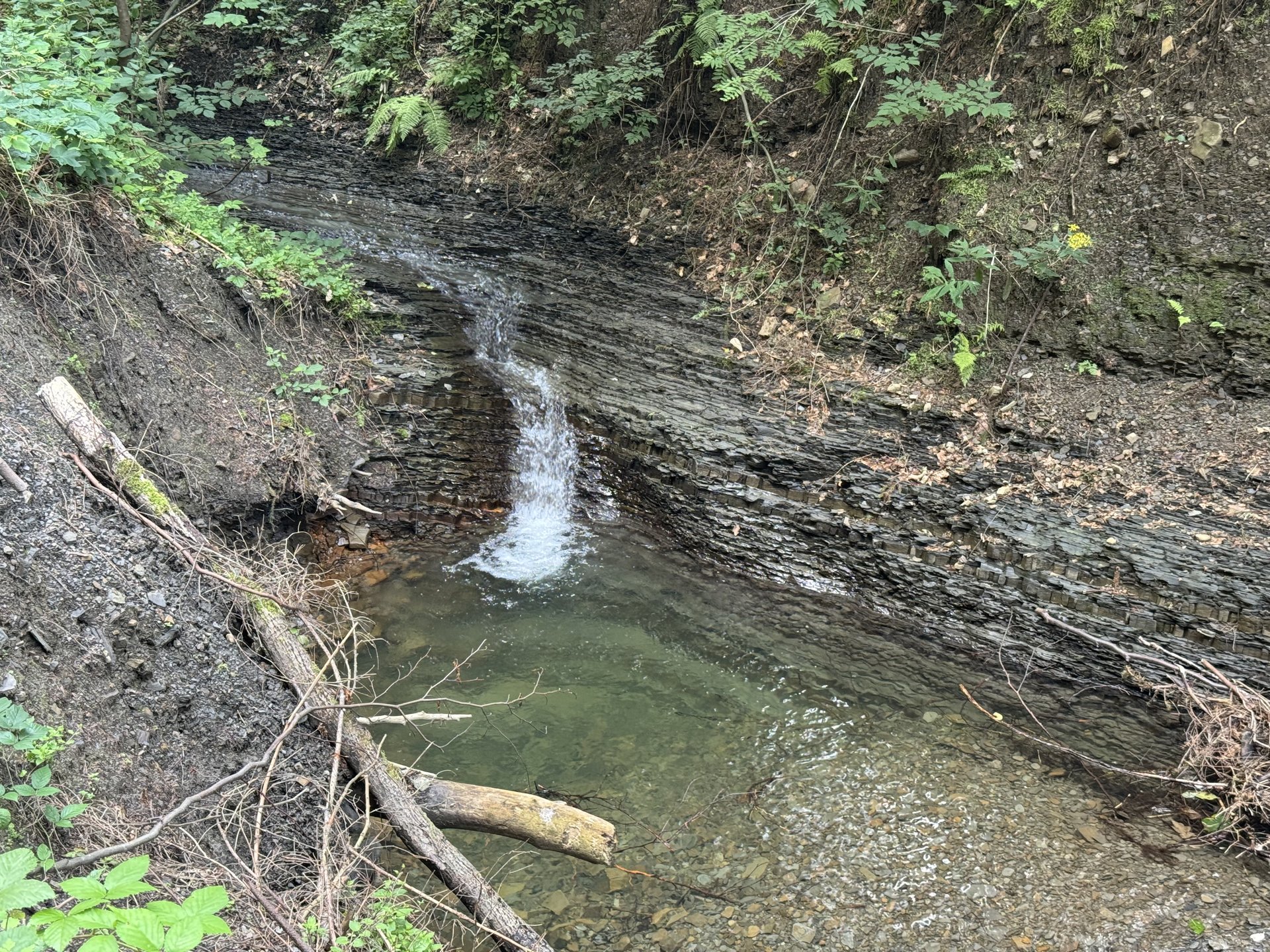
The river remained beautiful, with slate formations creating perfectly flat but tilted sections, tiny stair-step waterfalls revealing thin geological layers. The rock looked like sandstone despite its slate-like layering—typical of Beskydy geology.
The Long Walk Home
From the back end of Šance dam lake, I faced sealed road walking—a section I’d disliked as a child, forced to follow the lake’s arms when surely a bridge would’ve been faster. Today I simply set a fast pace, making kilometers pass quickly. Numerous cyclists and hikers passed, but greetings had ceased—apparently unnecessary on sealed roads with heavier traffic.
Arriving at Ostravice’s burger place, I faced an unexpected problem: I wasn’t particularly hungry. After 36km with about 1,000m elevation gain, I could manage a burger OR a langoš, but not the feast of both I’d anticipated. Perhaps my body had adapted since the previous week? Then it struck me: breakfast. I’d eaten two large slices of 40% rye bread with butter and honey. Rye bread always keeps me satisfied for hours—combined with the gentler elevation profile of this trip, it had sustained me all day.
The burger wasn’t as good as usual either. Perhaps the chef had an off day, or perhaps nothing could match the satisfaction of last week’s well-earned feast after surviving on just two Tatranky bars.
Reflections on Change
The burger wasn’t as I remembered, but perhaps nothing could be. Twenty years ago, the wind turbine at Bílý Kříž was merely broken; now it was a skeleton being consumed by the forest. The grand Hotel Kysuca was a ruin. But where a beloved spring had vanished, a new one had appeared, its water just as cold, its gift just as welcome. The mountains endure, offering their mushrooms, berries, and their views, while our own landmarks rust and fade. Maybe that’s the lesson of the trail: you can’t go home again, but you can always find a new spring, a new path, a new reason to keep walking.
Note to self: If planning a trip around eating favorite foods at the destination, don’t eat breakfast that will sustain you all day. Some lessons we learn repeatedly, each time hoping for different results.