What Is This? One Day in Lisbon
March 23, 2026
“Buffet, buffet!” was the mantra of the morning as soon as the boys woke up. Our days always began with a hotel breakfast in one of the outer suburbs of Lisbon.
Among the usual spread and all sorts of interesting Mediterranean-like items, two sat unconspicuously in the middle of the cold cuts and cheese section, undescribed. One was white and wobbly like silken tofu. The other remotely resembled quince cheese. Both were presented in massive, generous slabs. There were descriptions for baked beans, bacon, sautéed vegetables — but not these two. The quince thing turned out to be exactly that: a solid paste of quince, cut like a soft cheese. The tofu-like thing was queijo fresco — very mild, good with olive oil and salt or with the quince.
In another country, this might have come with some fanfare — an “artisanal” label, perhaps a rustic wooden board. Here it was just a non-descript buffet item, sitting between the ham and sliced cheese. This was something I’d been noticing in Lisbon: quality stands on its own. It doesn’t need narration.
The Pond
The Navy building near the waterfront was painted light blue, almost baby blue. Still the Ministry of Defence — not a museum, not a monument, but a working building for what remains of a navy that once commanded half the world’s sea routes. The boys walked past it.
What they noticed was the pond.
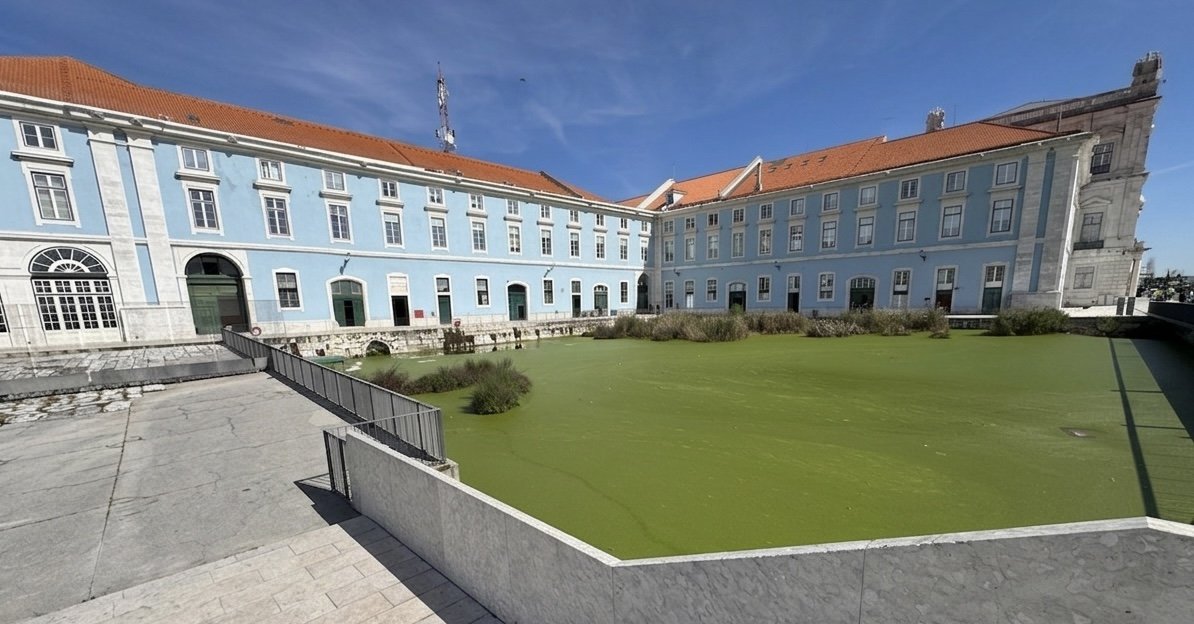
It sat beside the Navy building, facing the water, and it was not in good shape. Green algae covered the surface. Reeds grew at the edges. Clumps of grass and reed had broken free and were floating in the green, little islands drifting with no particular destination. The boys stopped.
The wind was pushing the grass islands across the pond, slowly, and where they moved they left dark trails in the algae — clean lines opening behind them like wakes. My five-year-old stood at the edge and watched one island cross from the reeds on the near side almost to the far bank. His brother tracked a different one. They stood there for ten minutes, maybe longer. I stood with them.
The historic palaces were nearby. We did not go to the historic palaces.
The water underneath the algae, where the trails opened, was clean.
The Ferry
We took the ferry to Cacilhas. The terminal was busy with commuters crossing the Tagus, and we joined them.
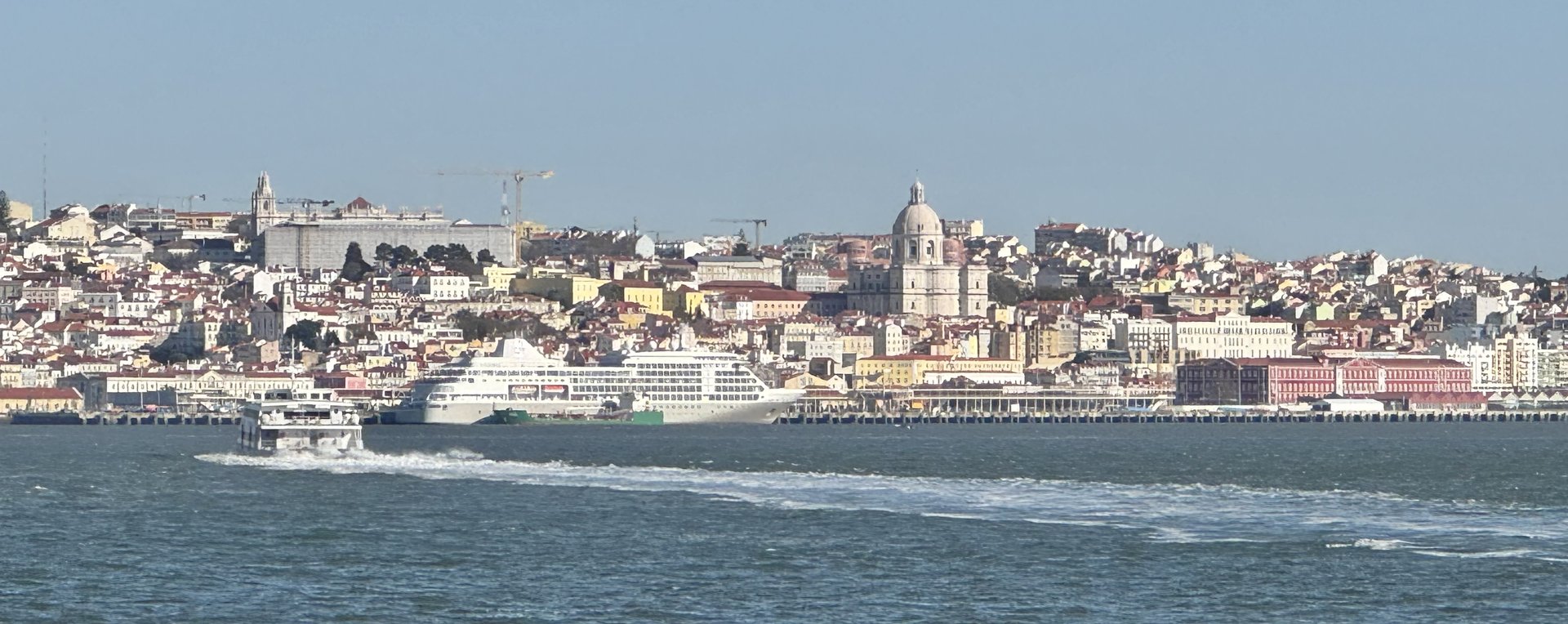
From the water, Lisbon rearranged itself behind us. The city rose up the hills, terracotta and white and pale yellow, and above it all the bridge. It looked like the Golden Gate — same colour, same international orange, same suspension-bridge elegance. The resemblance isn’t coincidence. The Ponte 25 de Abril was built by the American Bridge Company, the same firm that built the Bay Bridge in San Francisco. It’s not that Portugal copied California. It’s that Portugal hired California.
In the other direction, much longer and much lower, a second bridge ran close to the water and disappeared into haze. The Vasco da Gama — seventeen kilometres, the longest in the EU, named after the man who sailed to India five hundred years ago.
On the south bank, the Cristo Rei statue rose above the waterline, arms spread, facing the city. It looked like Rio de Janeiro. I kept reaching for other places to describe this one, and the reaching was the point. Portugal wouldn’t stay inside a single comparison because it had touched too many places, and now the echoes came back from everywhere.
The boys spotted the masts of a “pirate ship” from the ferry. So the plan became to head that way.
The Pirate Ship
The pirate ship turned out to be sitting in a dry dock beside a real submarine, and you could go inside both of them. A paradise for a five-year-old and an eleven-year-old.
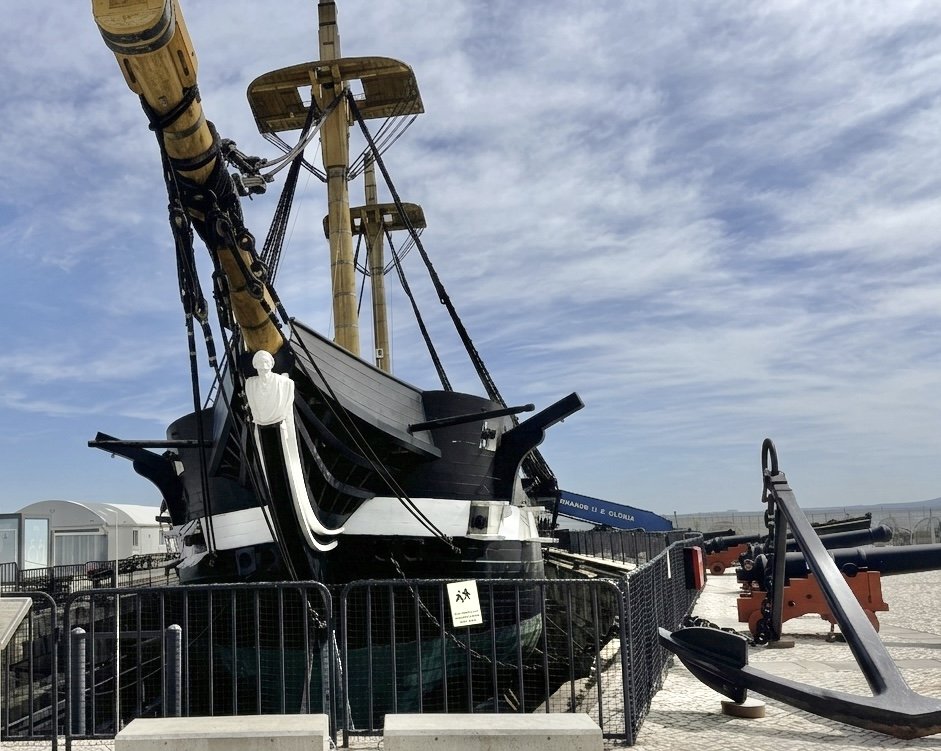
The ship was really a frigate — the Dom Fernando II e Glória, a wooden-hulled fifty-gun sailing ship, built in 1843 from Indian teak at a shipyard in Daman, then a Portuguese colony. She was the last sailing warship the Portuguese Navy ever built, and the last ship to make the Carreira da Índia — the India Run — connecting Lisbon to Goa since the sixteenth century. She sailed a hundred thousand nautical miles, then became a training school, then a home for orphaned boys, then caught fire in 1963 and lay half-buried in the mud of the Tagus for twenty-nine years before someone brought her back.
The submarine was the NRP Barracuda, diesel-electric, French-built, commissioned in 1968. She served forty-two years and covered the equivalent of thirty-six circumnavigations. Crew of fifty-four, thirty-five beds — they hot-bunked in shifts. Twelve thousand litres of water aboard, all for drinking. Nobody bathed.
The boys were in awe.
They climbed through the submarine’s hatches and pressed their faces against the periscope housing and ran their hands along the torpedo tubes. My five-year-old was impressed by a surprisingly large submarine kitchen. His brother wanted to know where they stored the torpedoes. They stood on the frigate’s deck and looked up at the masts and tried to imagine the sails. They saw the cannons and tried to lift the different-sized cannon balls. This was, by a wide margin, the highlight of their trip.
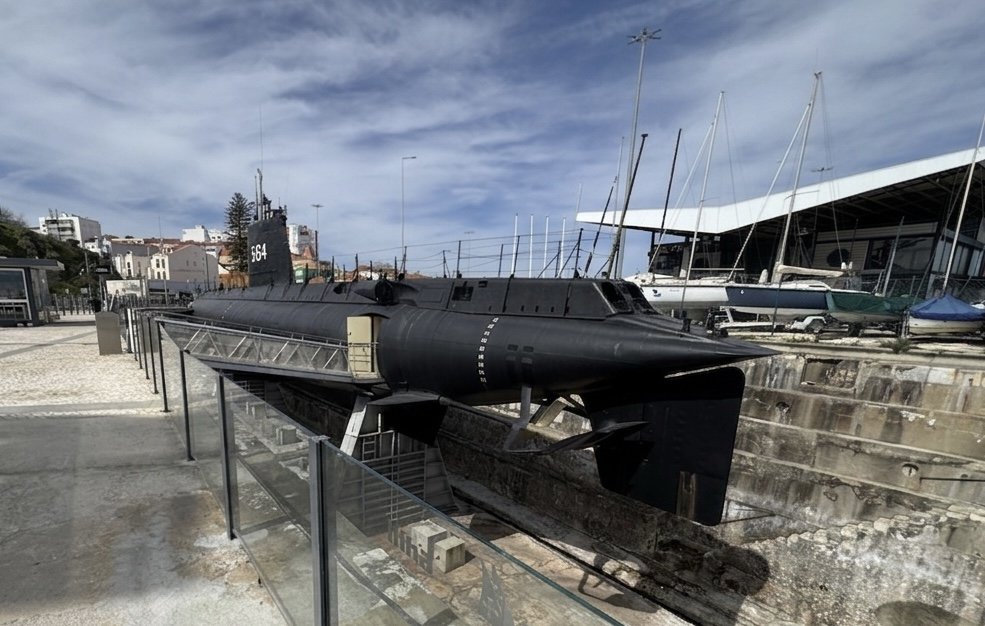
I tried to hold two thoughts at the same time. The first was that these were extraordinary machines — a frigate built from Indian trees for the route to India, a submarine that spent thirty-five thousand hours underwater. The second was that they were in a museum. They were not docked. They were displayed. The submarine was a serious boat, capable and real, but it was not a nuclear submarine. It was not the top-of-the-world kind. The frigate was the last of her line, the one that came just before steam made her obsolete. Everything in the dry dock was worthy of respect and also, quietly, a monument to the moment when Portugal’s reach exceeded what it could sustain.
The boys saw adventure. I saw a country visiting its past.
The Grill House
By evening, we were back in the neighbourhood. The boys were hungry.
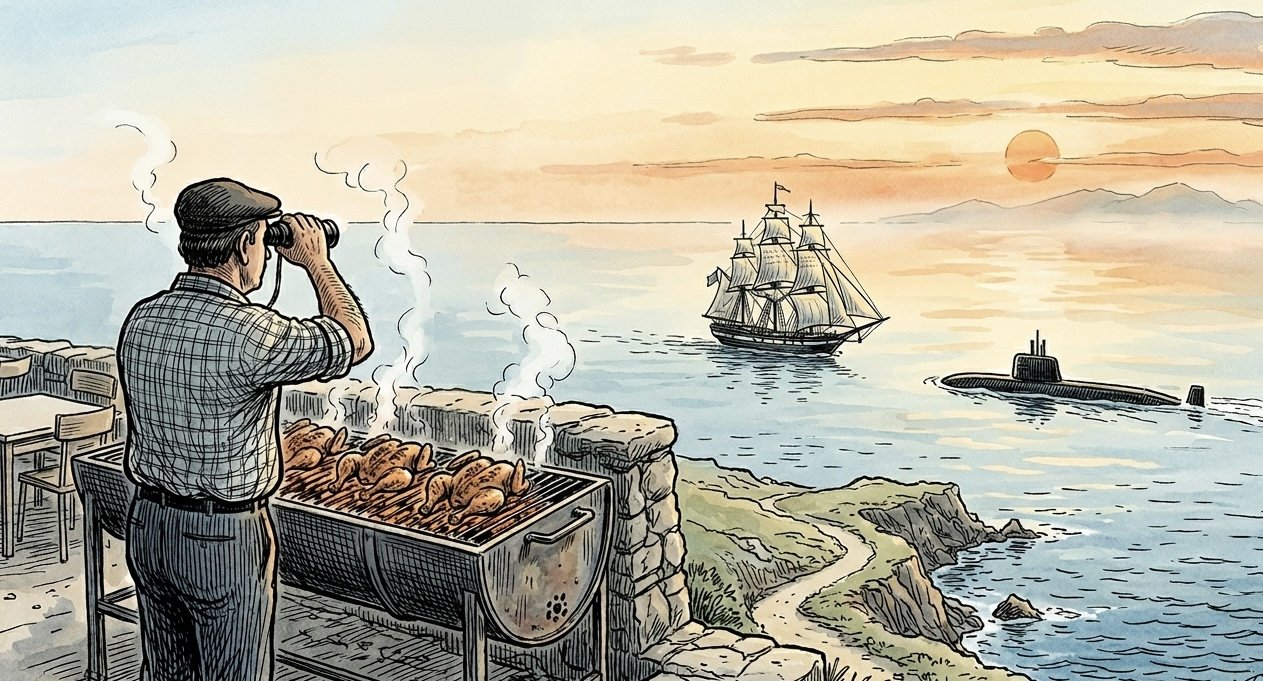
We stopped at a small place on a side street. A man was cooking chicken and sausages and ribs over charcoal, smoke drifting out toward the pavement. The boys were almost enchanted. But the guy sent us away — he was just getting the fire started. Come back in thirty minutes.
So we ordered a meal and went to the supermarket to wait.
It was a small neighbourhood shop. We needed a few things for the room, and I wanted a bottle of olive oil to take back. I found one on the shelf — Portuguese extra virgin, seven euros. A mid-range bottle in a country that grows some of the best olives in the world.
It had a theft-protection device clamped around its neck. The kind you see on bottles of spirits — a hard plastic collar that triggers an alarm if you walk out without having it removed at the register. I’d seen them on whisky. Never on olive oil.
We paid. The woman at the register removed the device without comment, the way she must have done fifty times that day.
Then back to the grill. The boys wanted to watch the meat over the fire, and they did, standing as close as the heat allowed. The uncooked chicken was very yellow. The signs showed no free range, or corn fed. Here just a chicken. The cooked chicken was smoky and crisp and slightly blackened and it was the best chicken we ate in Lisbon. There was no seating — we took it back to the hotel. In Melbourne or London, a place like this would have a write-up in a weekend supplement. Here it was just the place on the corner.
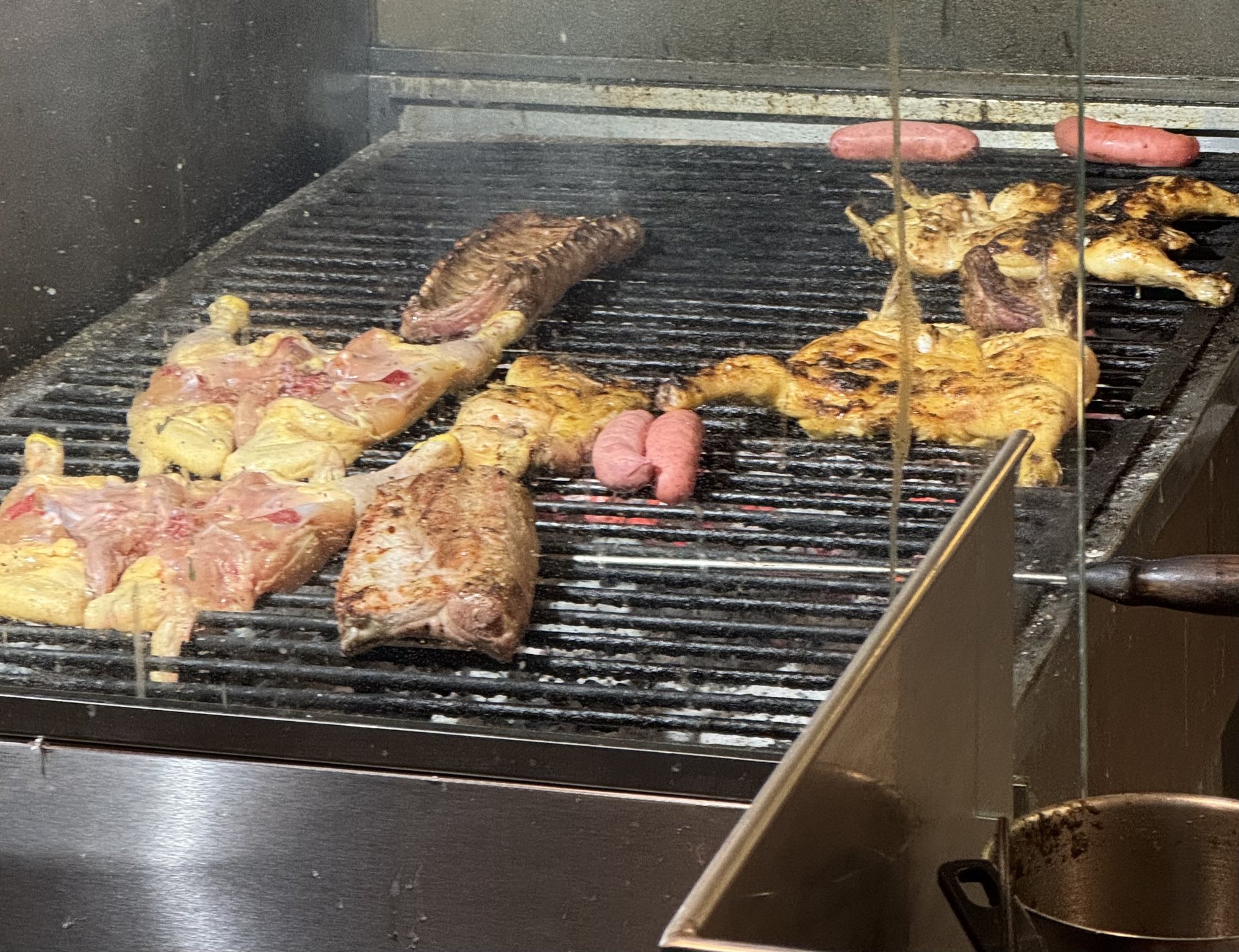
The boys demolished their plates. Sausage was the clear winner with them. The charred chicken was mine.
Placing Portugal
Later, after the boys were asleep, I lay in bed trying to place Portugal.
The food was Mediterranean — the olive oil, the grilled fish, the wine. The light was Mediterranean. But the ocean wasn’t. Portugal’s entire coast faced the Atlantic, and the wind that came off it was not the gentle breeze of the Côte d’Azur. It was the kind of wind I knew from the Taranaki coast of New Zealand — wind that had crossed a lot of open water and had not been softened by anything on the way.
The connections with South America were everywhere: direct flights to São Paulo, South American plants in the gardens, the Portuguese language binding two continents together. And pineapples — everywhere, all year round. They came from greenhouses in the Azores, where they’d been grown since the nineteenth century after a fungus killed the islands’ orange crop and someone thought to try cultivating the ornamental pineapple commercially instead. It takes two years to grow one. Nobody in Lisbon thought twice about them.
Not the monuments or the bridges — it was the way the country appreciated its history and yet wore it lightly that struck me. The famous custard tarts were everywhere too, always good, sometimes great; not a destination pastry but something you grabbed with your coffee. The fresh, well-cooked seafood was not a luxury; it was Tuesday lunch. The cork that padded the metro seats was not a premium material; it was what you sat on during your commute. The charcoal chicken was not artisanal; it was just the corner shop. A country that once sent ships to every corner of the world, and now the everywhere sent things back — plants from South America, bridge design from North America, tourists from all of Europe — and Portugal received it all with a grace I hadn’t expected. In a week of wandering with two children through neighbourhood supermarkets, local grill joints, the metro, the ferry, nobody had made us feel unwelcome.
Portugal doesn’t resolve into a single thing you can name. It has its problems. It expects quality but doesn’t narrate it. It’s the in-between empire — the country that touched everywhere and now sits at the edge of Europe, facing the ocean, reaching towards the Azores, Madeira and South America and at the same time looking forward towards Europe.
I thought about my son in the supermarket, turning the olive oil bottle over, examining the plastic anti-theft device with the seriousness that five-year-olds bring to things they haven’t seen before.
Tata, what is this?
I told him. He thought about this, nodded, put the bottle in the basket, taking it as it was, without fanfare or complaint.
Just that may have been the most Portuguese thing any of us did all week.